[TRACK] · Incident Responder
Incident Response Mock Interview with a Live AI Interviewer
A voice mock interview for incident response roles that asks real triage, containment and incident-command questions, follows up on your answers like a panel would, and scores you against a Junior-to-Senior+ ladder. First interview free.
updated 2026-09-09
In one sentence: a live AI interviewer that runs the incident you'd rather not get paged for, refuses to accept "I'd isolate the host" without asking what you'd lose by doing it, and tells you afterwards exactly where you stood.
Incident response interviews are different from most technical interviews. Half of them are scenarios you have to run out loud, and the other half are stories about incidents you actually handled, told under a panel that pokes at the parts that sound too clean. CyberLoop does both. This page shows the format, the kind of questions, a real exchange with the interviewer's pushback annotated, a real report card, and the price. It also says what this is not.
The format
- Voice, not text. You talk; it listens. Pause to think and it waits. Interrupt it and it yields.
- Two modes. Technical scenarios (triage, scoping, containment, incident command) and behavioral incident stories in STAR form. Pick one per interview.
- Follow-ups are grounded in your answer. It does not read the next question off a list. It asks about the thing you just said, until it either finds the bottom of your knowledge or you show there isn't one.
- A depth ladder from L1 to L4. Foundational questions first. Adequate answers climb; weak ones get a different angle rather than a harder question. Level calibrates the interview, never the score.
- Scored on three dimensions: technical depth, specificity, and communication. Behavioral interviews add story structure and how many distinct incidents you drew on.
- About 25 minutes for a full interview; the free first interview is a 10-minute version with the same report.
Questions you'll be asked
These are opening questions from the incident response track of our bank, verbatim, with what the interviewer listens for. Every one has follow-ups behind it that are not published, because the escalation is the interview.
Try it on an incident.
Ten minutes, no card, and the interviewer will push on whatever you say.
What pushback looks like
Below is a real exchange with the interviewer, from a demo session on our own account in the incident response track's behavioral mode. The answers were prepared in advance, which the interviewer noticed and said so in the report; the follow-ups were not. Lightly trimmed for length where marked.
This sounds finished. It has the right nouns (SOAR, EDR, volatile state, out-of-band telemetry) and a clear before-and-after. A question-bank tool would move on here. A hiring manager wouldn't.
The interviewer doesn't accept "implement a playbook." It asks how you would know it worked. This follow-up was generated from the answer, not pulled from a list, and it is the question that separates people who have run this from people who have read about it.
Now there are three things a hiring manager can check: a time-to-contain delta, an autonomy rate, and a false-positive rate with a stated meaning. The second answer is scored on its own; the first one isn't rescued by it.
It names what it heard, then moves on. The thread closes on evidence, not on a timer. Across a full interview this happens on every answer, at whatever depth your answers earn.
What you get afterwards
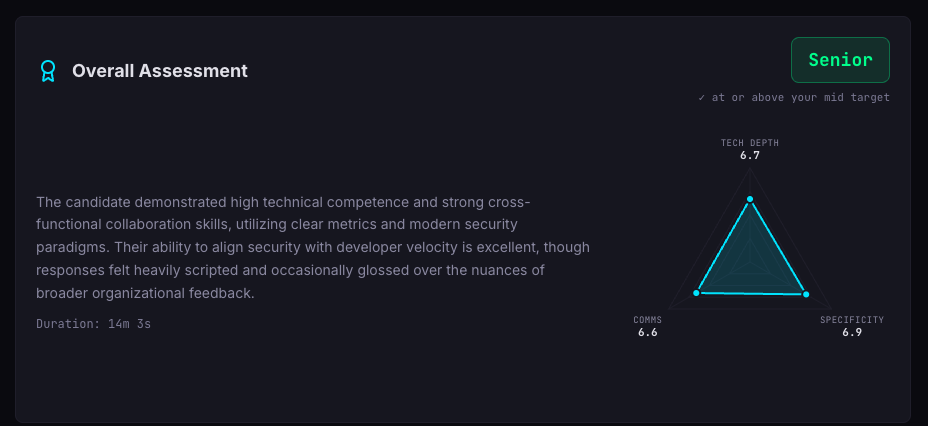
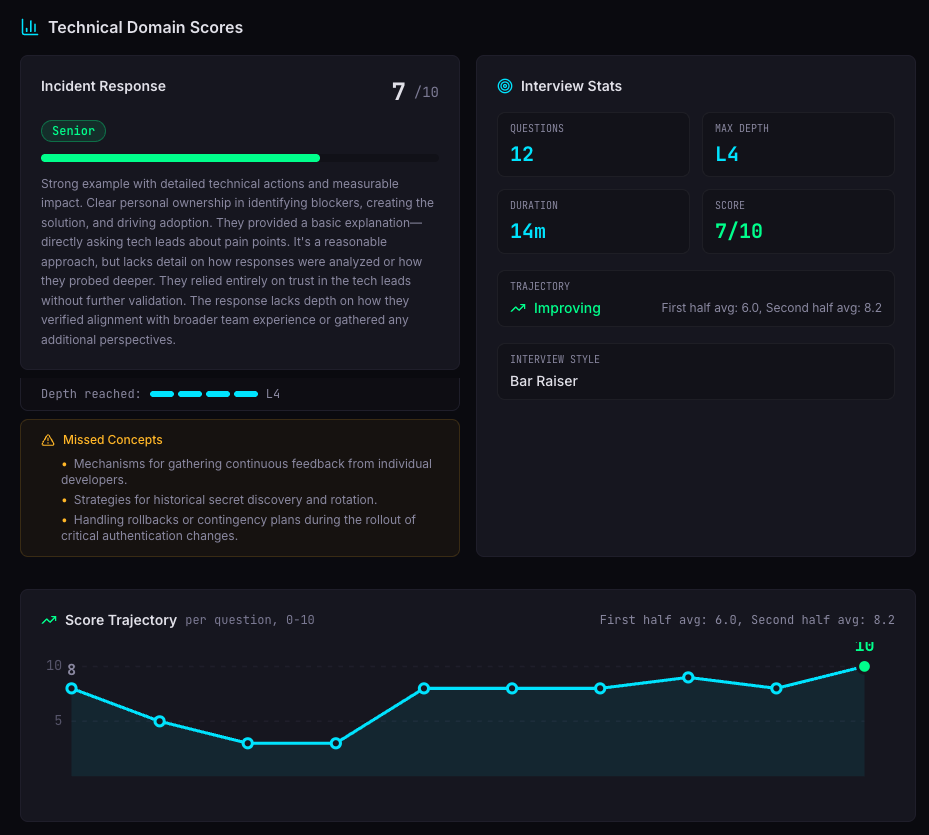
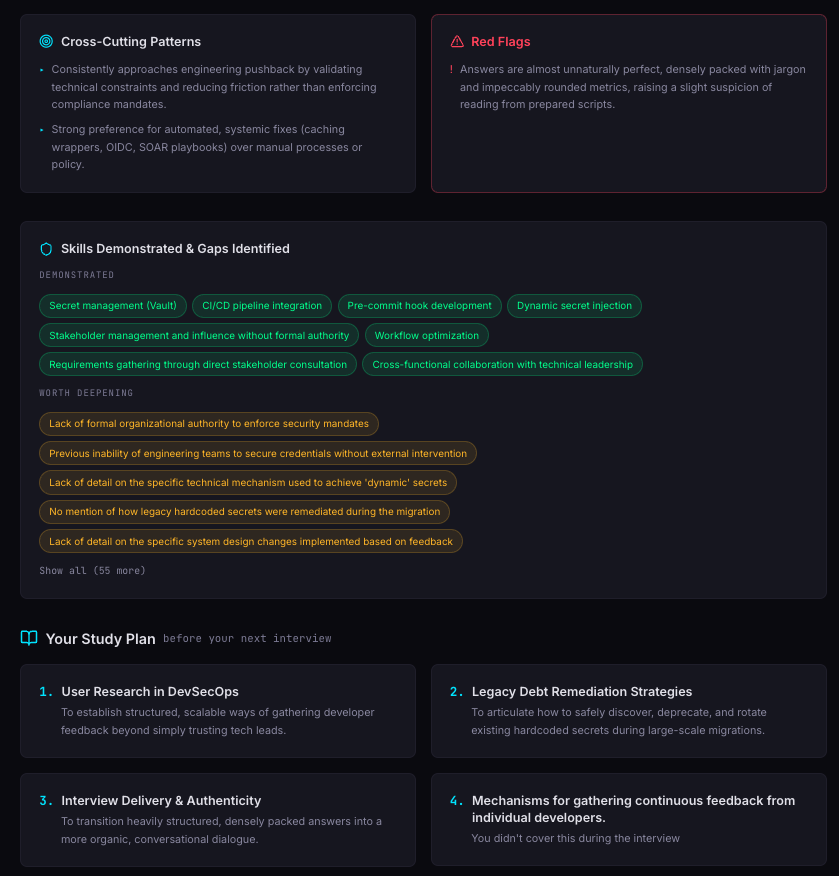
The report card from the same demo session, as the product renders it. Cropped, not edited; nothing on it was written by a person.
The same report, as data:
"High technical competence and strong cross-functional collaboration, using clear metrics and modern security paradigms. Responses felt heavily scripted and occasionally glossed over the nuances of broader organizational feedback."
- Consistent STAR structure with quantifiable security and business results.
- Builds "paved roads" for developers rather than relying on mandates.
- Depth across IAM federation (OIDC), secrets management, and automated response (SOAR).
- Over-reliance on tech leads as the single source of feedback; validate pain points with individual contributors.
- Delivery felt rehearsed, which hurts adaptability under unexpected follow-ups.
- Explain remediation of existing debt (how legacy hardcoded secrets were rotated and scrubbed), not just prevention.
Demonstrate broader organizational influence and systemic governance: company-wide standards and continuous, data-driven developer feedback loops, beyond individual squad architectures.
Notice the third improvement and the third study topic. The interviewer detected that the answers were read from a script and said so. That is the report working as intended: it grades the interview you gave, not the one you meant to give.
Price
No subscription. Interviews don't expire. You need a desktop Chrome browser, a microphone, and about 25 minutes for a full interview.
What this is not
- Not pentest, GRC, or certification prep. The bank covers blue-team roles: incident response, SOC, digital forensics, detection engineering, and threat intelligence. If you're preparing for offensive or compliance interviews, the comparison page says who does that well.
- Not a question list to memorise. The openers above are public; the follow-ups are not, and they are the interview.
- Not a tabletop exercise. It interviews you about incidents; it doesn't simulate one with injects and a clock. If you want that, run a tabletop with your team and then come here to practise explaining it.
- Not a human coach. A practitioner who knows your target company's loop will beat it on company-specific calibration. It costs $200 an hour and can't do 2 AM.
- Not a phone app. Yet.
If you'd rather read the questions first, the incident response interview questions guide covers the same track in text. If your target is a SOC role, the SOC analyst mock interview is the track for that.
Take the incident response interview.
Ten minutes, no card. You get the full report card and study plan.